

Have you ever heard about the concept if a tree falls in the woods, but nobody’s around to listen to it, it doesn’t truly make noise?
It’s similar to the idea of running a loyalty program without some strong marketing behind it. Without getting the message out, and telling the masses, does it even really exist?
Sure, loyalty programs can do incredible things for your business. Implementing a digital stamp card program with Loopy Loyalty into your daily operations can help retain current customers and enhance their purchasing habits. And this kind of program can drive new traffic towards your business.
Unfortunately, your loyalty program won’t make any noise — like the tree in the woods — if you don’t tell anyone. You may as well not bother purchasing the solution in the first place when you fail to inform the public of the many benefits.
More specifically, social media is the most prevalent form of marketing these days. Utilizing your platforms, whether its Instagram, TikTok, or Facebook, etc., can go far with informing a vaster audience about your loyalty program.
Read below as we examine various methods of promoting your loyalty program on social media.
Instagram Stories
In general, Instagram is ideal for reaching a vaster audience. You can use techniques, such as hashtags, to categorize your post in a relevant subcategory.
Beyond that, Instagram has a feature called stories, where you can produce a post that only exists for 24 hours. This makes it easier to generate newer content more prolifically. And you can take more risks that won’t necessarily fit your business’s overall theme and aesthetic.
Furthermore, with stories, you can include geographic location tags to make the content more discoverable to a local audience. You can even tag different people to get their attention in your stories.
These are all techniques you can utilize when promoting your digital stamp program via stories.
Here are some examples that you can look at for inspiration. You’ll notice that all these stories do possess an eye-catching aesthetic. So, while it’s less critical in stories to be perfect with your design, you still want to maintain a standard of equality.
Something else to notice is that many of the businesses in those examples are relatively vague with their explanation. There are pictures of a phone, to let audiences know that it’s a mobile device-based program, and usually something like “earn rewards.”
In some instances, there’s a QR code made available, that your Instagram followers/loyalty members can leverage.
You can also let your audience know the nature of your program and how you dole out digital stamps. Whether it’s 20% off after three purchases or a free item after $200 spent, it can be clarified and explained in your story.
Regular Instagram Posts
With Instagram posts, remember that they’ll remain on your wall permanently, so you’ll want to main a consistent aesthetic theme throughout your page.
Beyond that, there are many of the same benefits as with stories. Such as being able to geotag your location, use hashtags, and tag your audience.
And, unlike with stories, you have a comment thread that you can leverage to drive engagement and attention. You can write a caption that encourages your audience to interact with your content, asking an open-ended question like “What does customer loyalty mean to you?”
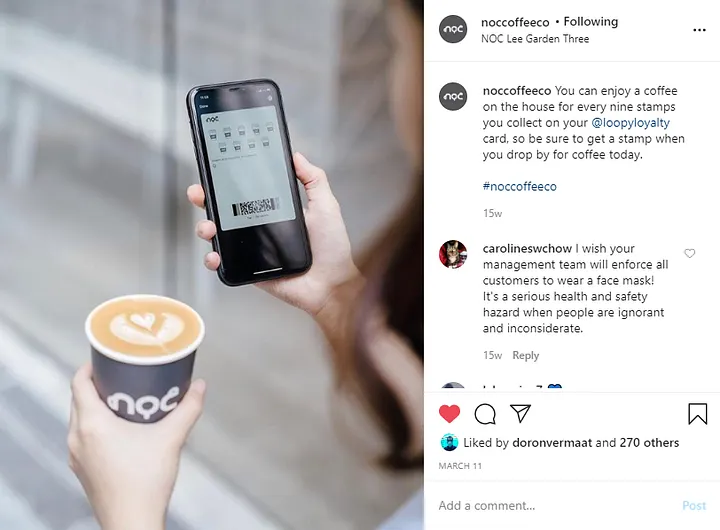
Here’s an example of an Instagram post promoting our digital stamp program. Again, what’s most important is highlighting the mobile device aspect, emphasizing the program’s pain-free element. It tells audiences that they won’t have to worry about forgetting their cards at home. Nor will your audience be concerned about losing a physical card and all the rewards they would have previously earned.
This other Instagram post from MNGO Cafe gives the audience all the relevant information about their program through the image and caption. From start-to-finish, the audience will know every step they must take to sign up and earn stamps.
Such an effort is visually appealing while making the process much more seamless and less clunky. As such, new members will feel at ease and more confident about joining.
What About Other Platforms?
The real-life examples we’ve used have been on Instagram — which is ideal for a lot of the businesses we work with. In today’s day and age, you’re best suited to finding one or two platforms that work for you.
Small business owners don’t necessarily have the time to focus on multiple platforms because it will overstretch their marketing.
In saying that, you must figure out where your demographic generally posts, which can be accomplished through some basic research. Otherwise, you won’t reach anyone with your loyalty program on social media, since you won’t be speaking to your target market.
Regardless of the platform, you need to suss out brand advocates who are willing to carry your message to their own audience.
Keep note of whoever is liking or commenting on your content and reach out to them with a direct message (if possible), perhaps offering them an influx of rewards for sharing your content. Most people trust this kind of word of mouth marketing more than when it comes from the company itself. After all, a referral from “real people” is more authentic.
Lastly, note what kind of posts tend to better on platforms.
On Facebook, for instance, videos generate far more engagement than written posts with images. A video is even more engaging when it has closed captions.
So, if your demographic tends to post more on Facebook, a video (with closed captioning) breaking down the intricacies of your digital rewards program will generate the most buzz.
You’ve Got to Be Social to Attract Loyal Customers.
In 2020, there’s no marketing without social media marketing. And if you intend to maximize the return on your loyalty program investment, you’ll only find success by reaching the masses on the relevant platform.
Follow the formulas that have worked for many other businesses and combine it with your usual excellent products and services. This way, you’ll find the success that you deserve.